
Peak Oil is You

Donate Bitcoins ;-) or Paypal :-)


Peak Oil News and Message Boards

Ocean container shipping rates could test record highs as Iran war fuel spike drives rise, analysts say
LOS ANGELES, Sept 17 (Reuters) - The off-contract ocean container shipping rate from China to the U.S. East Coast has returned to levels seen after COVID-19 upended global trade, and could set new record highs as the U.S. and Israeli war on Iran drives fuel costs higher. The spot rates on that route hit $10,948 per 40-foot container, more than quadrupling since the start of the Iran war on February 28, according to data from freight pricing platform Xeneta. "That leaves freight rates on these critical trades just short of the all-time high set during the COVID-19 disruption," Peter Sand, Xeneta's chief analyst, said of the route, where rates hit a record $11,900 in January 2022. The Shanghai to New York route is among the busiest and most profitable for global container carriers, including MSC, Maersk, COSCO and CMA CGM. Crude oil ...

EXCLUSIVE: Putin envoy and far-right AfD prepare talks to get Russian gas back for Germany, sources say
BERLIN, Sept 18 (Reuters) - Russian President Vladimir Putin's top economic envoy and Germany's far-right AfD leadership have begun preparations to meet next year to discuss restarting gas supplies to Europe's biggest economy, two people familiar with the plan said. The discussions for a meeting as early as March underline the close relations between Moscow and the AfD, which, although blocked from power by a coalition of its rivals, is Germany's most popular party with voters. The meeting would be attended by Kirill Dmitriev, who is a close adviser to Putin and who heads Russia's sovereign wealth fund, as well as AfD co-leaders Alice Weidel and Tino Chrupalla, one of the people said. A spokesperson for the AfD and a representative for Dmitriev declined to comment. Before the sanctions imposed over Moscow's full-scale invasion of Ukraine in 2022, Russia supplied more ...

DOE Issues 7th Emergency Grid Order to PJM in 2026
The Department of Energy has handed PJM Interconnection the legal power to commandeer backup generators across the Mid-Atlantic, and it did so on 17 September 2026 with a single signature. Order 202-26-45, issued under Section 202(c) of the Federal Power Act, gives the grid operator authority to activate standby generation across its territory for a two-day window closing at the end of 18 September 2026, a measure designed to hold off uncontrolled outages during a late-summer reliability crunch. This is not a one-off. It is the seventh Section 202(c) emergency order DOE has issued to PJM in the 2026 calendar year, each triggered by the same underlying strain: demand outrunning available supply as conventional plants retire, seasonal generation fades, and new large loads keep arriving on the system. At the moment Order 202-26-45 took effect, PJM gained three specific powers it ...
Denouement to the Latest Oil Price Scare
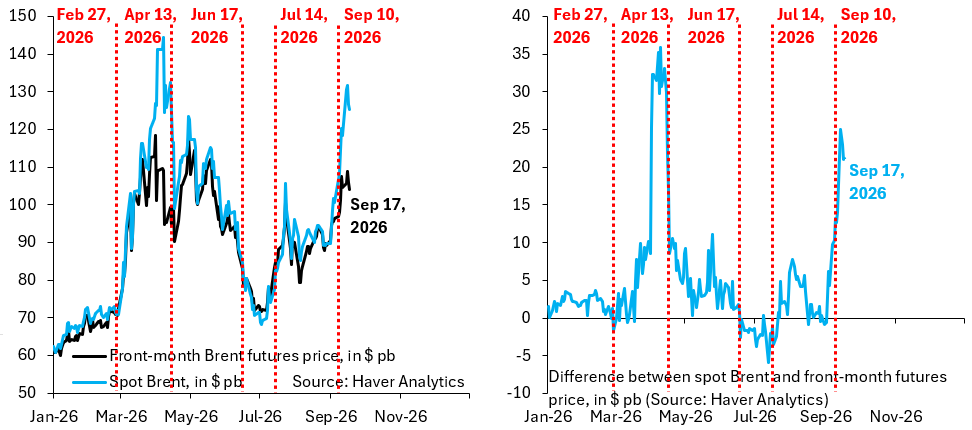
For the past six months, I've pushed back hard on the idea that the Brent oil price will go to $150 or $200 a barrel for two reasons. First, the Strait of Hormuz is an absolutely huge bottleneck for global oil supply, so - if prices didn't go crazy - it must be because demand is more flexible than many thought. This has been the cornerstone of the case I made in a post and podcast with Paul Krugman back in March, when I used the mid-point of academic estimates for the price elasticity of demand to show that the peak in oil prices for a meaningful encumberment of the Strait of Hormuz is $125. Second, the global supply chain for oil has proven way more resilient than many anticipated. Some countries - like China and Japan - had big ...
‘What took Hezbollah 20 years, Houthis developed in five’: Saudi Arabia scrambles for air defenses as Shanghai crude hits record $129
Saudi Arabia's stockpile of interceptor missiles is running low as fighting with the Houthis continues, and Riyadh has turned to allies in the West and the region for help, the Associated Press reported. Saudi Arabia has asked France, Britain, Pakistan and Egypt to send air defense assistance to help intercept missiles and drones launched at the kingdom by the Houthis or other Iran-backed militias. The United States is Saudi Arabia's main supplier of interceptor missiles, but dwindling U.S. stocks in recent months prompted Riyadh to seek help from other allies. The Houthi seizure of a strategic stretch of Red Sea coastline, giving the group control of the Bab el-Mandeb Strait after it defeated forces of Yemen's Saudi-backed government, continues to raise concern around the world. Reuters reported that U.S. officials met representatives of the Yemeni rebels in Oman; the Houthis ...
Russia’s wartime economy faces long-term erosion from debt and military spending
FRANKFURT, Germany -- The frictions in Russia's wartime economy are growing, as massive military spending balloons the budget deficit. Consumers and businesses are gloomier. Growth has slowed. None of that, however, signals an imminent financial crisis or economic collapse, economists say. With crucial oil export revenues holding up due to high prices from the Iran war, the government is able to find the money to pay for its 4 1/2-year-old invasion of Ukraine, at least for now. Meanwhile, low unemployment and government largesse in poor regions help keep a lid on consumer grumbling. That picture suits the Kremlin's narrative of stability ahead of Russia's stage-managed parliamentary election that got underway Friday and concludes Sunday. But economists warn that longer-term problems are gnawing at the foundations -- and could one day result in a crisis. Indicators of consumer sentiment have drifted down ...
Qatar LNG shock raises winter bill fears, gas prices at near 4-year high
A prolonged disruption to Qatar's liquefied natural gas (LNG) exports after war damage to its main production facility is pushing Northeast Asian natural gas prices to their highest level in nearly four years, raising the prospect of higher electricity and heating costs in Korea this winter. The November futures contract for Japan Korea Marker (JKM), the leading price benchmark for LNG delivered to Northeast Asia, closed the previous session at $27.765 per million British thermal units, or MMBTU, the highest level since January 2023, according to Investing.com data on Wednesday. The figure is also up 30.85 percent from a month earlier and 71.55 percent from six months earlier. JKM is a key benchmark for LNG delivered to Northeast Asia, including Korea and Japan. Unlike crude oil, which is traded at broadly recognized global benchmark prices, LNG prices vary by region ...

Seminar On Future Of LNG in Asia In Light of Iran War
The growing instability in the Gulf region means that policymakers, companies, and investors now have to reconsider plans they made based on the premise that the supply and price disruption caused by the war in Iran was temporary. The expansion of the closures to the Red Sea, the shutdown of a major Saudi pipeline, and the possibility that other countries and terrorist groups could use the same energy weapon have all added to fears that past premises are no longer reliable. One policy put into doubt is Japan's efforts to promote the expansion of natural gas in Southeast Asia and to prolong the use of gas and coal through co-firing with ammonia and hydrogen. On Sept. 10th, the author participated in a video seminar called Six Months of Hormuz Disruptions: The New Asian Power Market Realities that focused on the prospects ...

China faces oil challenge as prices soar and supply options narrow
Oil prices in China have surged to record highs amid mounting disruptions to exports from the Middle East, as Beijing faces an increasingly difficult balancing act between securing its own energy supplies and preventing global oil prices from climbing even higher. Saudi Arabia has been forced to shut a key pipeline that had become an important route for getting oil to China and other Asian markets while disruption in the Strait of Hormuz restricted exports through the Gulf. The pipeline, which carries crude across the Arabian Peninsula to the Red Sea, was shut following attacks by an Iran-backed group in Iraq. Its closure leaves two vital routes for Middle Eastern oil to China both disrupted in the midst of the US-Israel war on Iran and conflicts in the wider region. With access to Russian and Iranian crude also complicated by ...

JP Morgan says it has no clear oil market endgame as Iran conflict drags on
Sept 17 (Reuters) – JP Morgan said on Thursday that it does not have a clear baseline view for oil markets for the first time since the start of the US-Israeli war on Iran. "We simply don't know how to model the endgame," analysts at the bank noted. The note flagged that at the beginning of the conflict, JP Morgan had assumed there were some economic thresholds that the U.S. administration would not cross, but six months into the conflict, many of those lines have been crossed with no clear exit strategy in view. The bank noted that oil prices have climbed above $100 a barrel with gasoline at $4.37 a gallon. It also noted that US diesel prices have hit an all-time high of $6.31 a gallon heading into winter, the period of peak seasonal demand, while inventories sit ...
Michigan gas prices near $5 a gallon as Iran war threatens more pump painGas prices surged across Michigan on Sept. 16 with some stations charging nearly $5 ...
Russia Cuts Off Gas to Armenia Days After Diversification AnnouncementBy Eurasianet - Sep 17, 2026. Gazprom Armenia suspended Russian gas deliveries from September ...
 Oil supply fears ease on Saudi workaround via Oman
Oil prices continued to decline in early trading on Thursday after Saudi Arabia was ...
Oil Above $100 Pushes U.S. Fuel Prices to New RecordsOil markets appear to have reached the inflection point that many analysts had predicted ...

Oil News Categories
Recent Board Topics
Archive
Member Comments
- on Export Constraints Curb Kazakhstan’s Ability to Offset the Global Oil Shortage
- on StanChart Warns Oil Is Now Built for Sharper, More Frequent Spikes
- on US oil floated on cheap money
- on US oil floated on cheap money
- on U.S.-Venezuela Oil Deal Threatens China’s Oil-Backed Loans
- on What to know about the Southcentral Alaska gas crunch
- on US Strategic Petroleum Reserve falls to lowest level since 1982
- on More than 20% of global refining capacity at risk of closure
- on Trump and Venezuelan Oil: 65 Billion Barrels on Paper. Almost None in the Tank.
- on Russia’s fuel crisis returns as Ukrainian drones target oil facilities
- on The Story of Oil 1822–1922
- on Venezuela’s Oil Exports Fall Even as U.S. Shipments Hit Seven-Year High
- on Venezuela’s Oil Exports Fall Even as U.S. Shipments Hit Seven-Year High
- on Venezuela’s Oil Exports Fall Even as U.S. Shipments Hit Seven-Year High
- on Opinion: What China’s ‘oil fortress’ means for Canada’s West Coast bet
- on Opinion: What China’s ‘oil fortress’ means for Canada’s West Coast bet
- on Heat – the new supply shock
- on Before Greta Thunberg, there was “Peak Oil”. Has everyone forgotten?
- on “This Is Unprecedented”: Goldman Sachs Sees 3 Simultaneous Crises Pushing Oil as High as $120 a Barrel
- on White House Weighs Extending Historic Jones Act Waiver to Lower Gas Prices
PO Real Time
No tweets available